
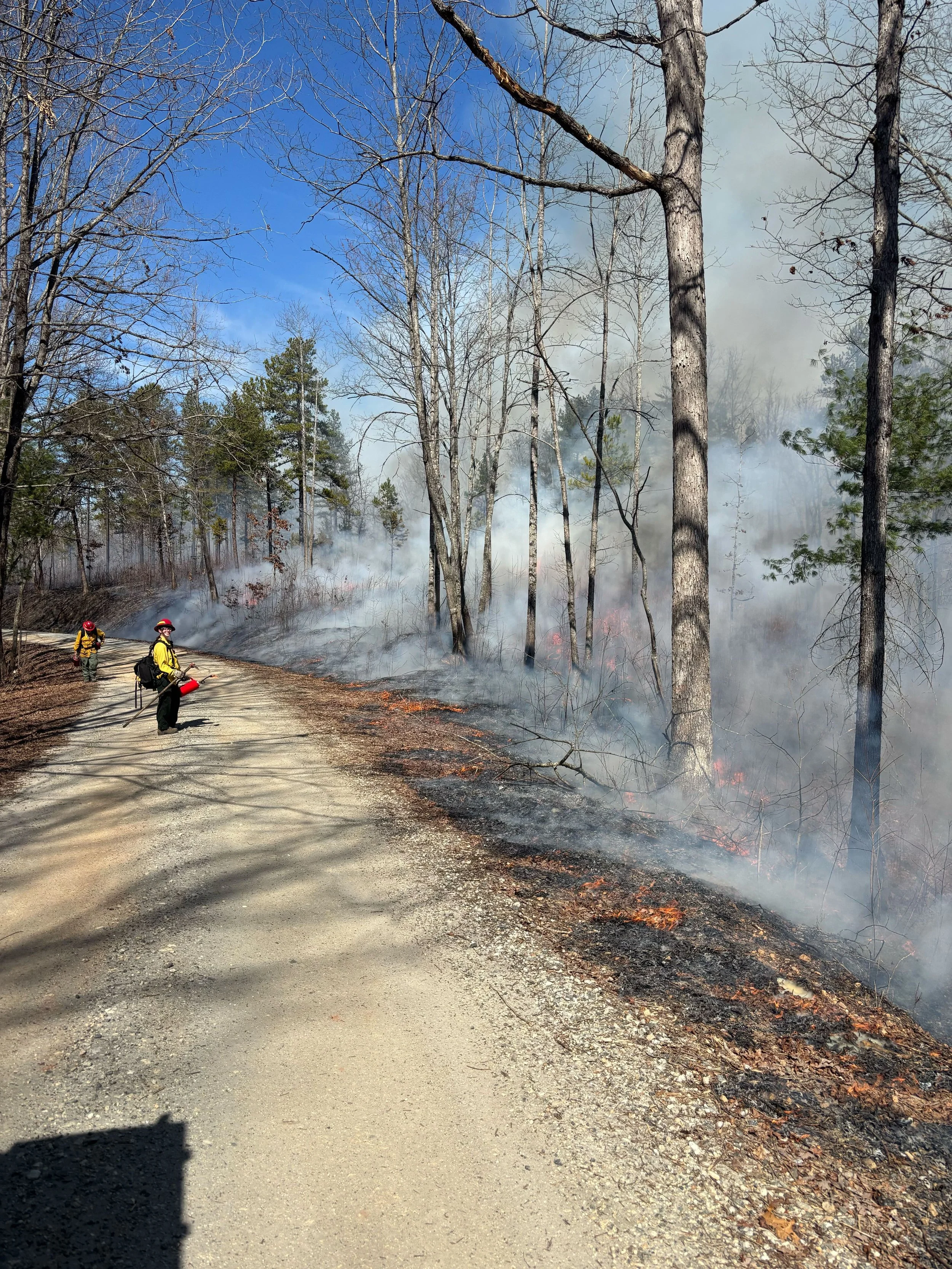
This fall, PRLT is conducting its first prescribed fire. Conditions permitting, it will take place at Steep Falls Village Preserve on Saturday, October 24, and will be executed in partnership with Standish Fire-EMS.
Prescribed fires are common tools for managing grasslands and vegetation in the southern parts of the United States, but are relatively new concepts to the Northeast. We know people may be wondering: what is a prescribed fire? And why are we doing one at Steep Falls? I’m here to give some background and answer all your questions.
What is a prescribed fire and who manages them?
A prescribed burn (also known as a controlled burn or Rx burn) is a planned and intentional outdoor fire managed by trained experts. There are four courses a person must take before being officially certified as a Wildland Fire Fighter:
S-130: Firefighter Training
S-190: Introduction to Wildland Fire Behavior
I-100: Introduction to Incident Command System
L-180: Human Factors on the Fire Line.
These courses teach prospective firefighters about fire behavior, physical and mental safety within the job, and how to manage disaster scenarios efficiently. However, taking these courses is only the beginning for a wildland firefighter. Once the classes are complete, students must take a physical exam called the “pack test” to ensure that, in an emergency, they are capable of getting to safety without assistance. The test is a 3-mile flat hike with a 45 pound vest on, and it must be completed within 45 minutes. No running is allowed.
These courses and physical exams are intended to ensure the safety of the firefighters and local land owners. Some of the courses, along with the pack test, must be completed on a yearly basis as a refresher.
Why am I interested in prescribed fires?
I graduated from college in 2024 without a clear understanding of what work I was looking for. The first interview I had was through the Student Conservation Association with an internship under the U.S. Forest Service as a Wildland Fire Fighter. I was not overly excited: I never saw fire fighting as a potential career path. But one week into training and I was obsessed with fire management. I worked on the Andrew Pickens Ranger District in South Carolina under some of the most impressive people I have ever met. These supervisors had decades of experience and shared everything they could with me about this work. In my time with them, I was on three wildfires and five prescribed burns.
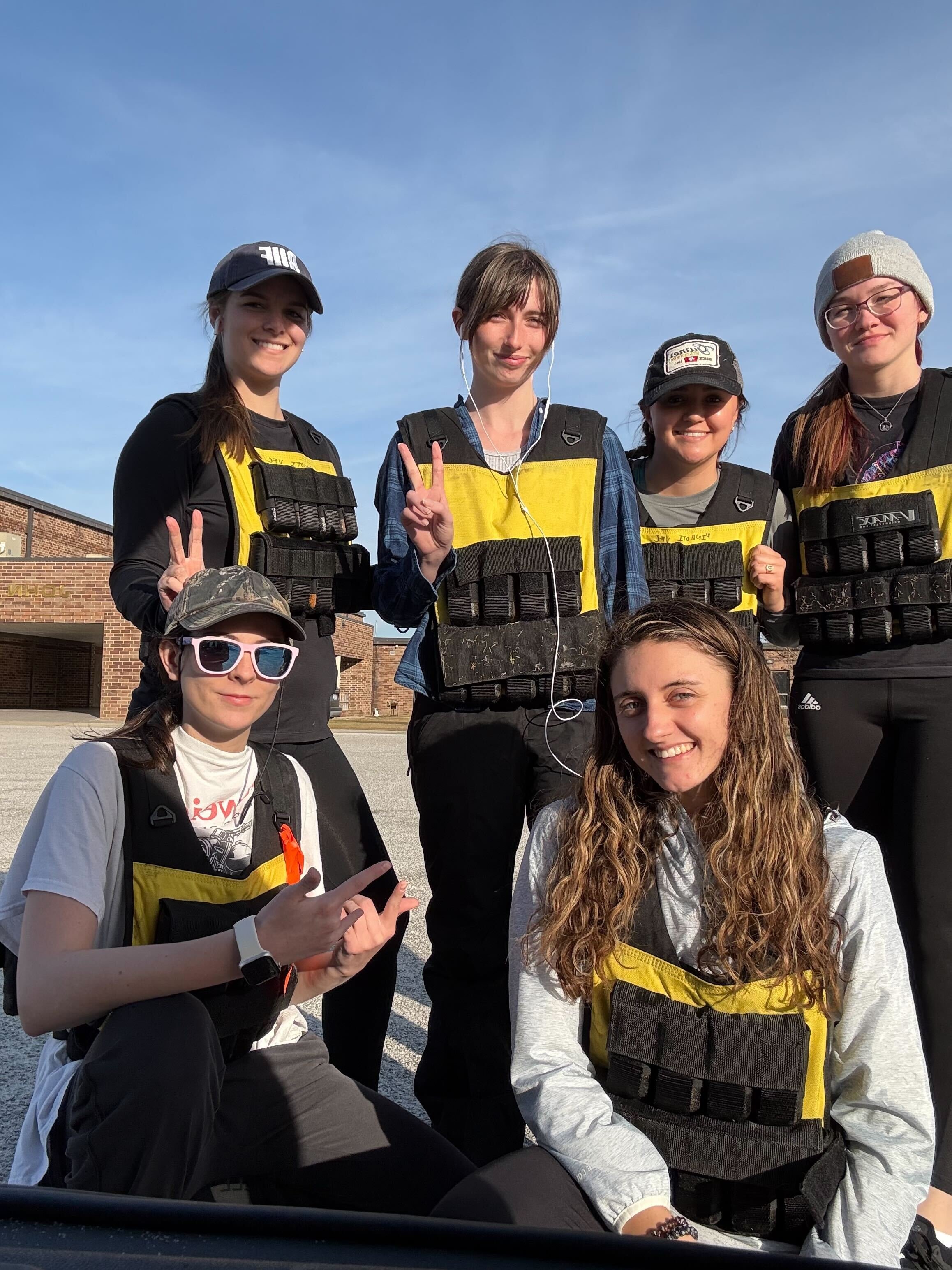
Right before my pack test in 2025. We all passed!
Me leading a small group through a 1000+ acre prescribed burn
After my time with the Forest Service, I still had a strong interest in fire ecology. Last summer, I worked under a Yale University PhD student to study the effects of fire on South Eastern U.S. ecology. This position gave me a more academic perspective of wildfire by seeing ecosystems recover years after being burned. I spent months measuring tree, fern, and bush growth. The study was starting to show benefits to native species.
Why is PRLT joining the prescribed fire world?
According to the Texas A&M Forest Service, prescribed fires “promote soil health, allow for more open and safe recreational opportunities, encourage growth of native species, and reduce non-native invasive species.” These are all important reasons why PRLT is interested in how prescribed burns can improve the land that we manage for wildlife habitat and public access.
We’ve chosen Steep Falls Village Preserve because of how difficult the grassland has been to manage manually. In the past, the grassland in Steep Falls Village Preserve was bush hogged for management, which uses a large, land-clearing tractor to remove thick brush and tall grasslands. It helps clear the area, but doesn’t provide nutrients back into the environment quickly. With the use of fire, we can keep plants short while also helping this grassland to become healthier.
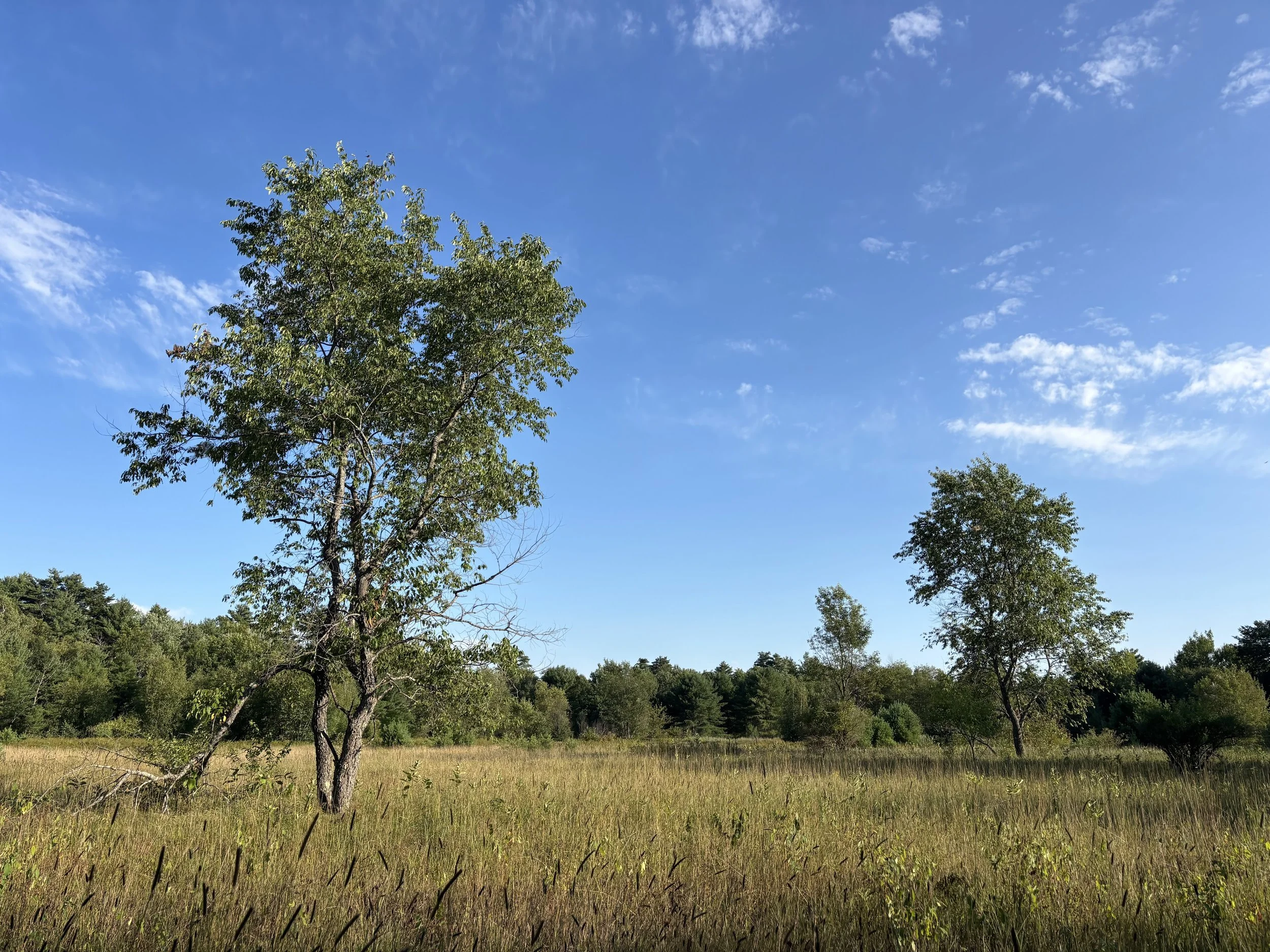
The grassland in Steep Falls Village Preserve
Prescribed burns also diminish the incidence and severity of wildfires by reducing flammable fuels. While Maine historically has not had wildfires on the scale of other parts of our country, The Maine Monitor reported that Maine had its worst August for wildfire activity in 20 years in 2025 (using data from the National Interagency Coordination Center). Whether we like it or not, wildfires seem to be becoming a greater seasonal issue in the North East. In the case of wildfires, it is far better to be proactive instead of reactive. This is why prescribed burns are very important: if a wildfire breaks out, reducing fuels in this area will help mitigate fire spread and possible damage.
What can you expect in the days before, during, and after the prescribed fire?
Part of the training I mentioned earlier includes an understanding of fire behavior, which goes hand in hand with weather. I have been monitoring weather conditions in the area for months. Given the recent drought, I had some concerns that the fire would need to be delayed; however, recent precipitation and dropping temperatures have made it safe to proceed at this time. Along with situational awareness work (a.k.a. being aware of common and environmental hazards), fire lines must be built. Fire lines are perimeters designed to keep the fire from spreading outside of the intended parcel. Their width is measured by assessing the fuel type and height, then doubling that value to create a large barrier.
On the day of the burn, Standish Fire Lieutenant Will Watson will bring his crew, along with fire staff from other local municipalities, to conduct the fire. Watson has spent his entire adult life as a structure firefighter, and he has also joined the Maine Forest Service to assist suppression agencies in the Western U.S. with wildfire work.
This fire will be broken up into two parts of the day: an early morning burn and a dusk burn. These are the hours where relative humidity is high (moisture in the air helps to suppress fire) and the atmosphere is most stable (which creates more predictable fire behavior).
Mill Street, along with Mill Street Park and Steep Falls Village Preserve, will be closed the day of the burn to ensure the safety of everyone.
After the fire, teams will “mop up” the affected area, double-checking that all embers have been extinguished. If there are hot areas, these will be suppressed with water or hand tools. This process could take up to a week, and the preserve will be closed the whole time. We’ll announce on our social media when we are done mopping up and are reopening the preserve.
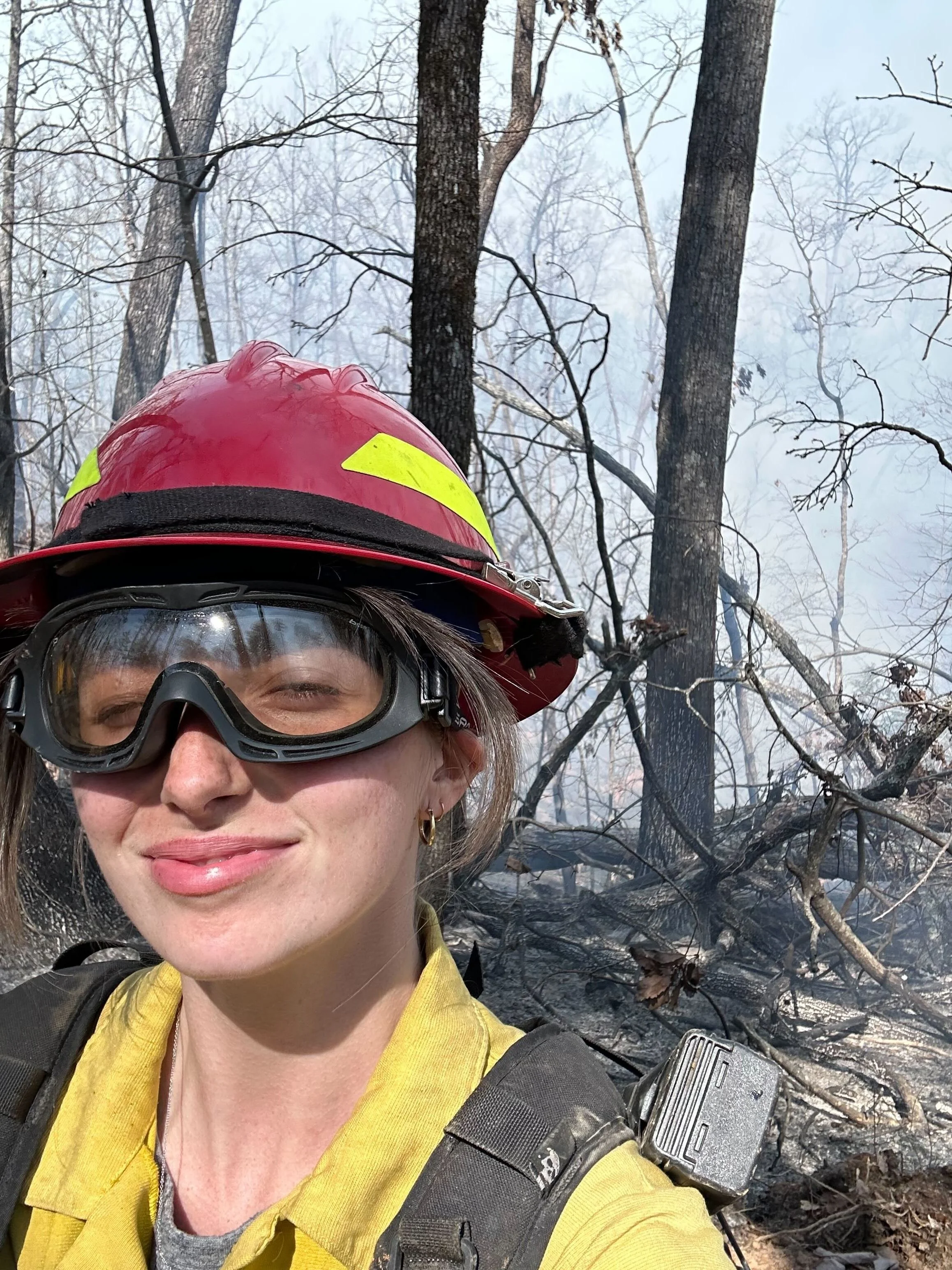
Selfie while “mopping up” after a wildfire with the U.S. Forest Service in South Carolina
What is our goal for this burn?
PRLT wants to gain a better understanding of whether prescribed burning is a useful tool for our organization. This fire is taking a lot of planning hours, but like much else in life, the first burn is always the hardest. Standish Fire-EMS has been an amazing partner in getting this operation organized. Hopefully, this will be a long standing relationship with future burns in consideration. We are very excited to see this project come to fruition and learn how it can help us advance our conservation efforts through successful land management.
Abigail Edenfield is an PRLT’s 2026 Environmental Steward from Maine Conservation Corps, an Americorps program based in the Maine Department of Agriculture, Conservation & Forestry.